
article
Texas Thread Theory: Building One Storefront for All the Things We Create
Texas Thread Theory started as a way to solve a practical problem: I wanted one storefront where merchandise from very different projects could live without forcing every brand to become its own ecommerce operation.
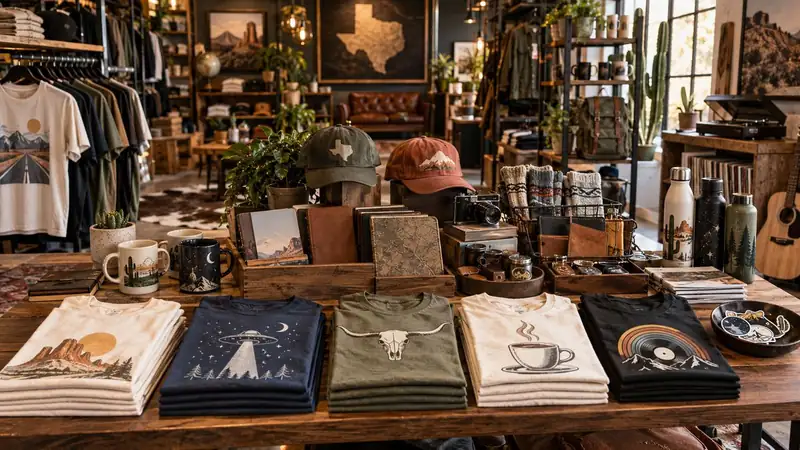
Texas Thread Theory started with a pretty simple problem.
I keep building things.
Some of those things are websites. Some are media brands. Some are photography, videos, music or ideas that eventually turn into products. As the number of projects grew, so did the number of times I thought, “This would make a good shirt.”
The obvious answer would have been to build a separate store for every brand.
I did not want to do that.
Texas Thread Theory Started With a Pretty Simple Idea
The original idea behind Texas Thread Theory was to create one place where I could make merchandise around the different subjects and projects I care about without pretending they all belong to the same brand.
That distinction matters.
A shirt inspired by a paranormal project should not suddenly look like a Houston food shirt because they happen to share a checkout system. A travel design should be able to feel completely different from something created around media, coffee or Texas culture.
The storefront can be shared.
The creative identity should not be.
That became the basic theory behind Texas Thread Theory: one home for the products, but enough flexibility for the individual ideas to keep their own personality.
I Didn't Want Every Project to Need Its Own Store
Running a separate ecommerce experience for every property sounds organized until you imagine actually maintaining all of them.
Every store needs products, navigation, support, updates, policies, quality control and all of the details that are invisible when somebody simply sees a shirt they like.
I would rather put that energy into the designs.
So instead of turning Paranormal Unknown into a merchandise company, the paranormal-inspired products can live inside Texas Thread Theory. The same approach works for Travel with Melvin, Houston Food Fanatics, All About The Life and Mode Digital Media.
Each project can stay focused on what it is supposed to be.
Texas Thread Theory becomes the place where the physical ideas connect.
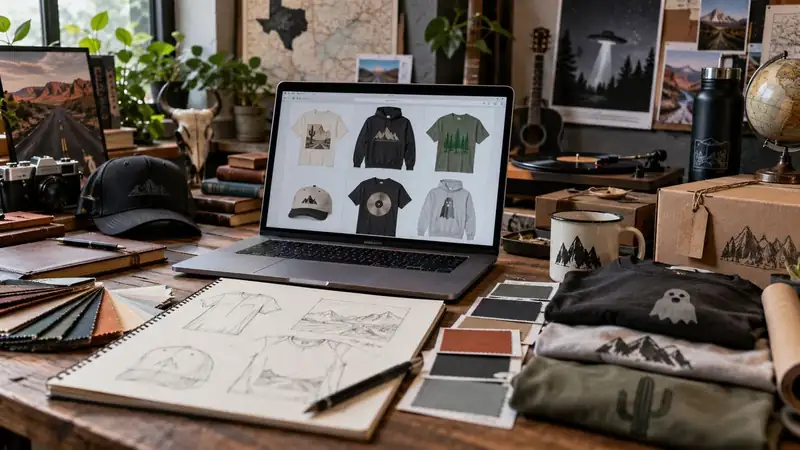
A Paranormal Shirt Should Still Feel Paranormal
This sounds obvious, but it is one of the things I care about most.
If somebody likes a paranormal design because it feels eerie, curious or strange, the fact that it is sold through a larger storefront should not dilute that.
The same applies in the other direction.
Food merchandise should be able to be funny, local or hungry-looking. Travel designs can be nostalgic or adventurous. A media or creative-tech design can be cleaner and more modern. Texas designs can lean into a completely different visual language.
I do not want the store to flatten those differences.
The point of a shared storefront is operational simplicity, not creative sameness.
Merchandise Is Another Form of Brand Design
The more I work on merchandise, the more I think of it as another extension of the brand rather than a separate product category.
A website has typography, imagery, tone and pacing.
A shirt has composition, color, scale, garment choice and the question of whether somebody would actually want to wear it when they are not standing inside your brand.
That last part matters.
There is a difference between putting a logo on a shirt and designing something that can stand on its own.
Sometimes the right answer is a strong brand mark. Other times the brand is only the starting point and the better idea is a phrase, illustration or visual that makes sense even to somebody who does not know the backstory.
I find that part much more interesting than making promotional merchandise.
Some Designs Start With the Brand. Others Start With the Idea.
Not every product needs to begin with one of my existing properties.
Some designs start with a place, a mood, a phrase or something I simply want to make.
That gives Texas Thread Theory room to be broader than a network merchandise shelf.
It can be the storefront for the brands, but it can also be a place for standalone ideas that would never justify their own website, social profile and entire identity.
That flexibility is one of the reasons I like the model.
It lets a small idea remain small enough to be fun.

The Tools Have Changed How Quickly I Can Explore Ideas
This is another area where newer creative tools have changed what is practical.
I can move from a rough concept to several visual directions much faster than I could a few years ago. AI can help explore compositions. Kittl can help develop print-ready graphic concepts. Adobe tools give me more control when I need to refine an asset. The ecommerce platform handles the product side once the design is ready.
The speed is useful because merchandise benefits from experimentation.
A concept that sounds great in a sentence can look terrible on a shirt.
The faster I can test that honestly, the faster I can move on or improve it.
That does not mean every idea deserves to become a product.
It means I can find out sooner.
Having More Tools Doesn't Mean Everything Should Look AI-Generated
This is the part I keep coming back to across almost everything I build.
Having AI available is not a creative direction.
I do not want every shirt to have the same hyper-detailed generated look. I do not want every illustration to feel like it came from the same prompt. I do not want every product page to read like the same template with a new noun swapped in.
The useful part of the technology is speed and possibility.
The judgment still has to come from somewhere else.
For Texas Thread Theory, that means the product should feel appropriate to the idea that created it. Sometimes that will be clean type. Sometimes it will be vintage. Sometimes it will be strange, loud, minimal, photographic or illustrated.
The store should make room for all of that without making the collection feel accidental.
One Storefront Gives the Ideas Somewhere to Go
I have years of ideas sitting in folders, notes, photo archives and old projects.
A lot of them do not need to become companies.
Some of them might make a great shirt.
That is the role I want Texas Thread Theory to play.
It gives the physical side of these projects one place to live while letting the individual brands stay focused on the audiences and stories they were built around.
I am sure the product mix will keep changing because the projects keep changing.
That is fine.
The important part is that when one of those ideas turns into something I would actually want to wear, I finally have somewhere to put it.