
Video
How Lovestitched Turns a 48-Hour Prompt Into an Awkward, Playful Matchmaking Comedy
Melvin Maya’s short film uses a strict competition brief to build a story around Samantha Morgan Stitch, a hopeful setup, and the kind of date that can go off track in a hurry.
A comedy built from a tight prompt
Lovestitched is easiest to understand as a comedy that grows out of restriction. The 48-hour format gives the film a narrow set of ingredients, and the finished short uses those pieces to shape a story about matchmaking, attraction, and the strange pressure of trying to force a connection into place. The result is not a broad sketch or a random string of jokes. It is a compact, situation-based comedy that keeps returning to one idea: a person can be very confident in the idea of bringing two people together and still have almost no control over what happens once they sit down across from each other.
The direct answer is simple. This is a story about Samantha Morgan Stitch, a hobbyist who helps arrange a match for a father worried about his daughter’s love life. From there, the film moves into an awkward date, a few comic reversals, and a final stretch that leans into music and mounting flirtation. The tone stays playful, but it is built on discomfort, hesitation, and the gap between intention and outcome.
Samantha Morgan Stitch turns matchmaking into a profession
The film’s central character introduces herself with a name that already feels like part of the joke. Samantha Morgan Stitch carries a stitched-together identity in the best sense: she presents herself as someone who “stitches” people together, and that idea becomes the engine of the story. She is not framed as a polished professional with a formal office full of credentials. Instead, the film presents matchmaking as one of her hobbies, which gives the whole setup a slightly improvised feel.
That choice matters because it keeps the comedy personal rather than procedural. When the father explains that his daughter has been on many dates without finding one that lasts, Samantha’s confidence lands as both reassuring and a little overcommitted. She promises that the next match will stick. The phrase itself is doing double duty: it sounds like a sales pitch, but it also hints at the film’s main joke, which is that relationships are harder to hold together than a cheerful promise makes them sound.
The film also uses the wording of the prompt in a way that feels built into the character. Samantha’s hobby is not just a side note; it is the thing that makes her seem oddly suited to this request. That helps the short avoid overexplaining itself. Instead of pausing to justify why this person would be trusted with the job, the film simply lets her own enthusiasm carry the scene.
The story moves by awkward dates and small reversals
Once the match is underway, the film shifts into a date structure built around tiny social hesitations. Two people meet, test each other, and try to find something easy to say. Coffee becomes the obvious setting because it gives the story a plain, low-pressure place to let the awkwardness show.
The dialogue and behavior are the point. The characters exchange small questions about what they like, where they go, and what they do, but none of it comes out cleanly. Even the introductions feel a little unstable, which gives the film room to make comedy from the most basic parts of meeting someone new. The repetition around names and greetings creates a rhythm that is less about polished banter and more about the social strain of remembering how to behave.
The date then tilts into physical and comic disruption. A spill, a startled reaction, and a visible sense that something has gone off script all work together to keep the scene from settling into simple romance. That is one of the short’s smartest moves: it does not pretend a good setup guarantees a smooth connection. It lets the date wobble, and that wobble becomes the joke.
There is also a nice tension between what the characters say they are doing and what the scene actually feels like. One person talks as if the meeting is straightforward and promising, but the staging suggests uncertainty at every turn. That contrast gives the film its shape. The audience is not waiting for a big twist so much as watching the social friction build in real time.
Why the film feels like a team exercise
The creator context around the film makes clear that Lovestitched was made as a joint effort, bringing back past members of Degens’ First Rodeo and adding new faces to the mix. That matters because the movie itself has the feel of a group that is learning how to move together quickly. In a 48-hour project, the pressure is not just to finish; it is to arrive at a shared tone before the clock runs out. This short comes across like a film that understands that limitation and uses it well.
The comedy does not depend on elaborate setup or heavy exposition. Instead, it uses straightforward scenes, quick character cues, and a few strong comic pivots to keep moving. That makes the film well suited to the format. The audience can follow the setup immediately, then watch the dating premise unfold without needing a long backstory. The story is simple, but it is not thin. It stays focused on the social mechanics of a blind date and the mismatch between confidence and chemistry.
The musical stretch near the end also helps the short feel like a team piece rather than a single-note gag. The song-like passage adds energy and lets the film expand briefly beyond dialogue. It does not change the premise; it gives the premise another register. That kind of shift is useful in a short film because it keeps the audience from feeling locked into one rhythm for too long.
What the comedy is really doing
At the center of Lovestitched is a familiar but effective comic idea: people often speak about romance as if it can be organized like a service, but chemistry refuses to behave that neatly. Samantha can promise results. She can sound persuasive. She can even speak with the certainty of someone who believes she has the right touch. But once the date begins, the film lets the uncertainty breathe.
That is what gives the short its appeal. It is not trying to solve romance; it is trying to make the attempt itself funny. The father wants help. Samantha wants to help. The date exists because of that promise. Then the film watches what happens when the messy part begins. The comedy lives there, in the mismatch between a neat intention and an unruly human exchange.
For viewers coming in through the 48-hour angle, that is probably the main thing to notice. The brief is visible in the structure, but the short does not feel mechanical. It has enough personality to make the setup feel like a story rather than an assignment. That balance is what keeps the film watchable beyond the novelty of the challenge.
Watch the original video
Watch the original video on YouTube ↗
All About The Life
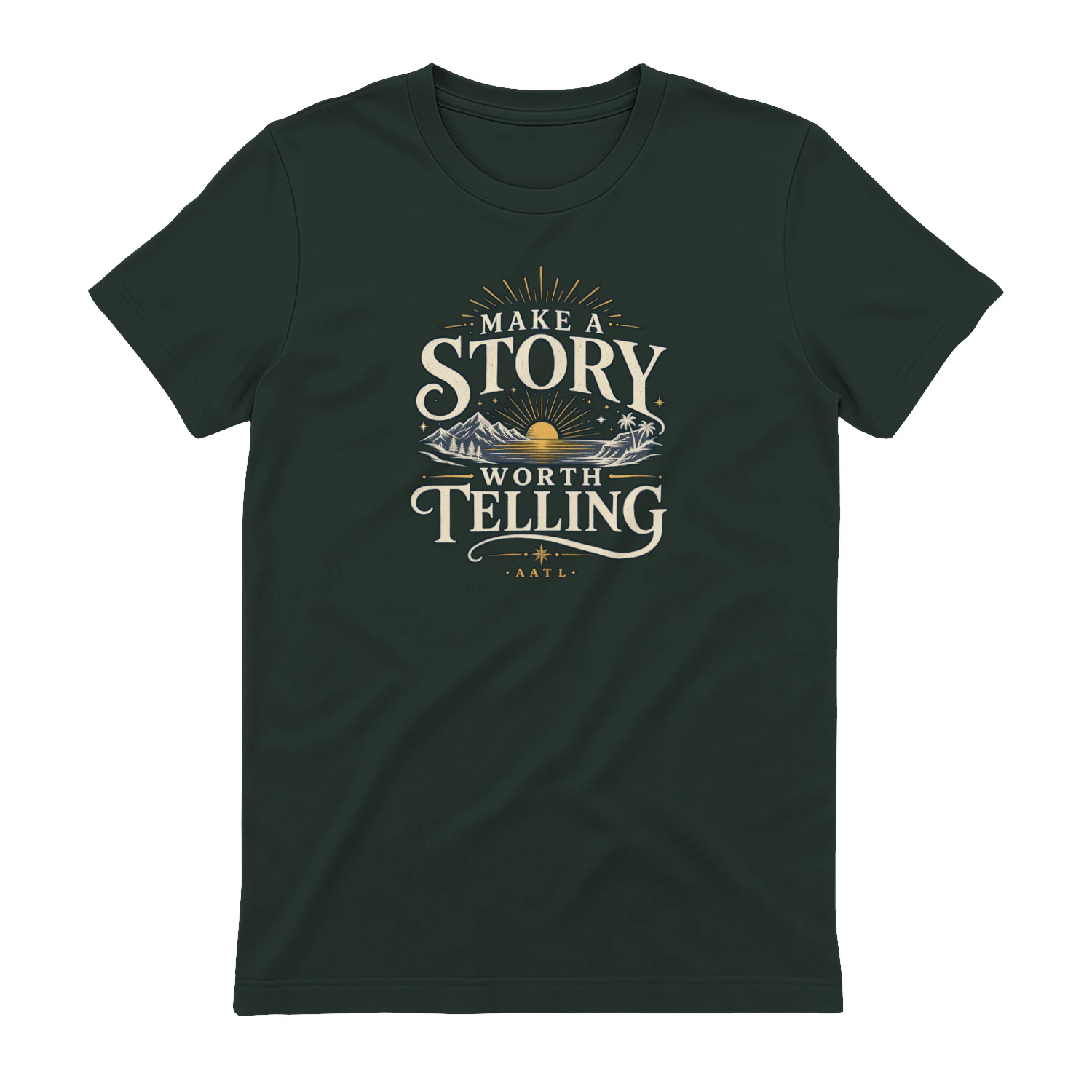
Make A Story Worth Telling
A scenic vintage-inspired design that encourages you to “Make A Story Worth Telling.” Mountains, water, sunset, and tropical details give it an adventurous feel that’s perfect for travelers, explorers, and anyone who wants a life filled with moments worth remembering.