
Video
Melvin Maya’s First YouTube Live Was Really a Blueprint for What Comes Next
In his first live stream, Melvin Maya answered questions about Ren, reaction videos, cameras, travel, and a new mobile format he hopes will bring strangers into the frame.
Why this live stream matters
Melvin Maya’s first YouTube Live was not really about “going live” for its own sake. It was a working conversation, a long first pass at answering what the channel is, who it is for, and where it can go next. If you want the direct answer, here it is: the stream was a creator Q&A that doubled as a roadmap. Melvin talked about his path into YouTube, his reaction-video habits, the equipment he uses, the music he keeps returning to, and a new idea that could take his reactions out of the studio and into public spaces.
That mix matters because the stream was not polished in the way a launch video often is. It was open-ended, improvised, and shaped by the comments moving in real time. In that sense, it gave a clearer picture of how Melvin works than a neatly edited upload often can. He is at his best when he is explaining process, not just presenting results.
A creator who arrived on YouTube by accident
One of the most useful parts of the live stream was hearing how Melvin got started. He did not frame YouTube as a long-planned career move. Instead, he described it as something that happened after a photo shoot video unexpectedly took off. That early clip, centered on blue-painted trees and body paint, became the video that introduced many viewers to his channel. The point was not only that it performed well. It also set the tone for how he thinks about making work: find a visually strong idea, do it differently from everyone else, and let the result speak for itself.
He also talked through the shape of his work before YouTube took off. Photography came first. Video came later, and it grew out of the same visual instincts. Before long, he was working in marketing, SEO, social media, and digital communications, which explains a lot about why his channel is organized the way it is. Even in a casual live stream, he kept circling back to systems, production, and audience reach.
Why Ren became central to the channel
A lot of the live stream naturally drifted toward Ren, and that made sense. Ren is one of the artists most closely tied to Melvin’s current audience, and Melvin clearly understands why. He kept returning to the idea that Ren is not easy to pin to one genre or one label. For him, that versatility is part of the appeal. Ren can move from deep, serious material to something lighter or more playful, and that range gives Melvin’s reactions more to work with.
Melvin also explained why he often starts with High Ren. That choice is not random. He sees it as a way to introduce people to the scale of Ren’s creative reach before moving into other songs. He described the performance as the kind of track that changes a person’s mood in stages: confusion, then attention, then emotional impact. That is one reason his reactions to Ren often follow a familiar path. He wants viewers to experience the same arc he sees in the song.
The live stream also showed how much Melvin values audience knowledge. He repeatedly said that comments from viewers have helped him understand Ren better, especially around details like the difference between Ren, The Big Push, and the newer material. He does not act as if he has all the answers. He uses the audience as part of the interpretive process.
Gear talk, from cameras to live production
For viewers who are interested in the technical side of creator work, the live stream was full of practical detail. Melvin walked through a long list of tools he uses depending on the project: Canon and Sony cameras, a Canon M50 for travel and compact shooting, a Canon RP for more photo-focused work, Sony a6400s for podcast and reaction setups, and older Canon bodies he still uses for other projects.
What came through most clearly was not brand loyalty but fit. He explained why he moved to Sony for long-form recording: time limits on some Canon video setups made them less convenient for extended sessions. He also talked about how much of his current reaction workflow depends on matching the right gear to the right kind of shoot. That includes his audio setup, his editing process, and even how he thinks about camera placement so viewers can still see the video he is reacting to.
He had similar thoughts about photography. He pushed back against the idea that you need the most expensive camera to make strong images. His view was more grounded: learn the basics, work within your budget, and pay attention to composition. That advice fit the tone of the whole stream. It was not aspirational in a vague way. It was practical.
The idea that could change how he makes reactions
The most revealing moment in the live stream may have been Melvin’s explanation of a new concept he has been building behind the scenes. He called it Gorilla Reactions, a mobile setup designed to let him take his reaction format out into public spaces and invite strangers to sit down with him on the spot.
The idea grew out of a problem he kept coming back to: guest coordination. Guest episodes tend to perform well, but scheduling friends and family is a challenge. His answer was to build a cart that replicates his studio setup in a mobile form. That cart, which he described as a compact, wheeled version of his recording environment, would let him set up in places like public parks and film reactions with people passing by.
That is a big idea because it changes the social structure of the channel. Instead of relying only on pre-arranged guests, Melvin would create opportunities for spontaneous reactions. It also fits the energy of his live stream itself. He likes process, movement, and the possibility of discovering a reaction in real time.
He was honest about the practical hurdles too. Power, internet, equipment safety, weather, and the logistics of moving expensive gear through downtown Houston are all real concerns. But the idea felt less like a passing thought than a next step he is actively trying to build.
What the livestream says about the next phase
The live stream also widened out beyond YouTube. Melvin talked about travel, especially the Philippines, where he attended a wedding and spent time in Manila and Boracay. He also spoke about the UK, his grandmother’s background, Houston’s diversity, the city’s tunnel system, the rodeo, and local food culture. Those details may have seemed scattered, but together they showed how he thinks: through place, experience, and the kinds of stories that can anchor a future video.
That is the larger takeaway from the stream. Melvin is not only trying to keep a reaction channel moving. He is trying to broaden the channel into something that can hold other kinds of stories without losing the personality that brought people there in the first place.
If the live stream proved anything, it is that his audience is already part of that process. The comments shaped the conversation, the questions steered the topics, and the whole thing became a preview of a channel that wants to keep growing without pretending it has all the answers yet.
Watch the original video on YouTube ↗
All About The Life
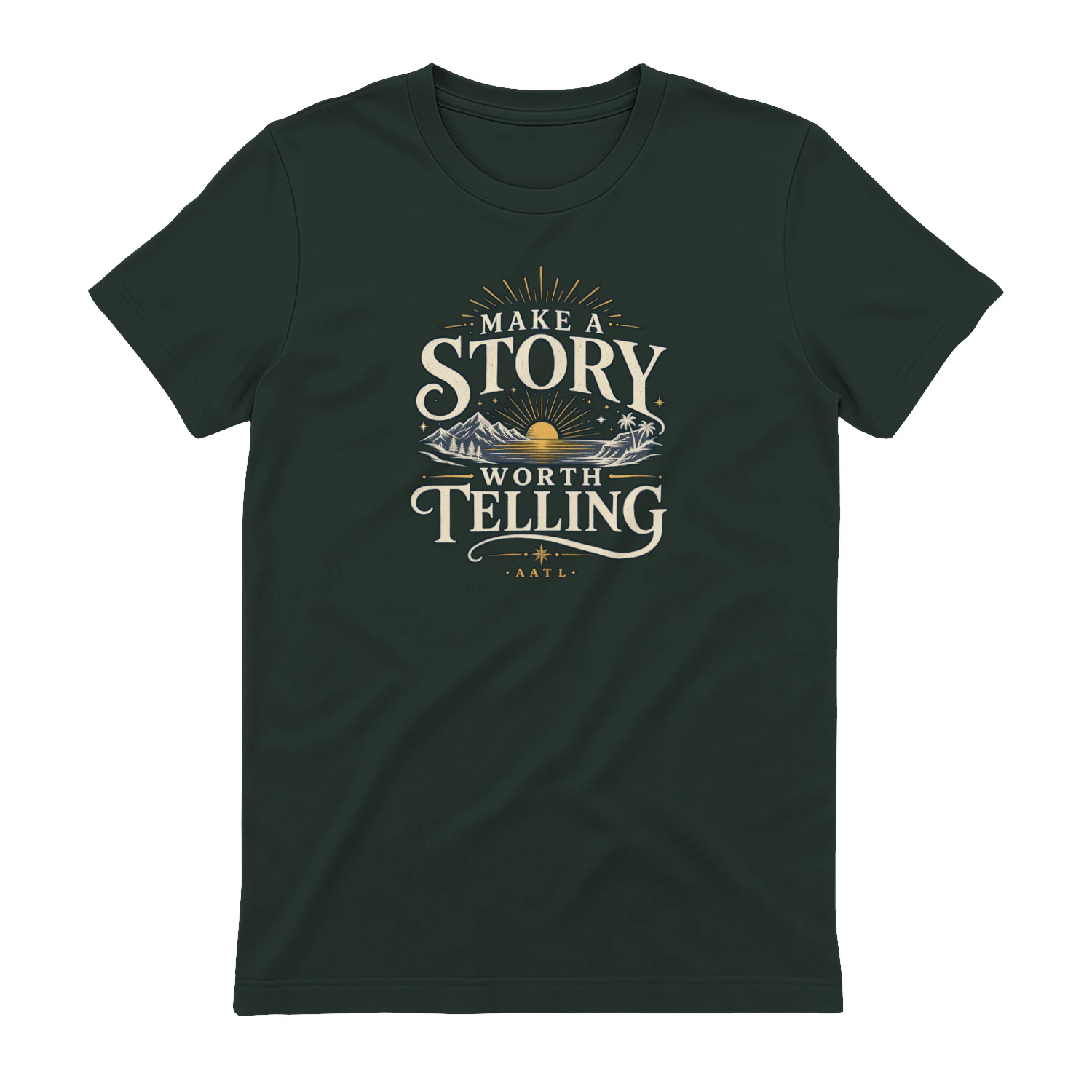
Make A Story Worth Telling
A scenic vintage-inspired design that encourages you to “Make A Story Worth Telling.” Mountains, water, sunset, and tropical details give it an adventurous feel that’s perfect for travelers, explorers, and anyone who wants a life filled with moments worth remembering.