
Video
Why Harry Mack’s Movie-Clip Freestyle Feels Bigger Than a Reaction Video
Melvin Maya’s take on Harry Mack and Dex Beats becomes a conversation about freestyle, hip-hop memory, and what happens when a beatmaker turns classic movies into prompts.
What the video is really watching for
The simplest way to describe this video is that Melvin Maya is reacting to Harry Mack freestyling over classic movie clips with Dex Beats in the room. But that description undersells what the conversation is actually doing. The clip is not just about whether Harry can rap quickly or whether the references land. It is about how a freestyle performance changes when it has a clear visual prompt, a beatmaker behind it, and someone in the reaction chair who understands both the craft and the culture.
The direct answer is that Melvin treats this as a freestyle conversation, not a novelty stunt. He is interested in how the setup gives Harry something immediate to work with while also keeping the performance rooted in hip-hop knowledge. That is why the reaction keeps circling back to the process: the beat, the movies, the timing, the memory, and the sense that what is happening is happening right now.
Dex Beats is the second story here
Dex Beats does not function like a background guest. Melvin makes a point of recognizing him as a producer, beatmaker, finger drummer, content creator, designer, and all-around creative. That introduction matters because it frames the clip as a meeting of people who build things, not just performers who show up to be impressive.
Dex’s own story in the video is grounded in making music for a long time and then starting to share more of that work online during the pandemic, when time and access changed. He also talks about coming from film, where he was editing beauty videos and later working around cosmetic clients long before YouTube was a familiar reference point in that world. Melvin clearly responds to that combination of technical comfort and creative instinct. He notices the way Dex presents himself, the look of the studio background, and the polished feel of the visuals.
That is part of what makes the reaction feel different from a standard watch-along. Melvin is not only hearing a beatmaker introduced as a collaborator. He is hearing someone whose camera work, visual instincts, and musical tools are all part of the same creative identity. In that sense, Dex becomes more than the person holding clips up on an iPad. He is the person designing the conditions for the freestyle to happen.
Why the movie clips change the performance
The movie concept is the hook, but it is also the structure. Melvin likes that Dex is not simply tossing out random words. He is using classic film clips, and that gives Harry Mack a set of images to react to in real time. The performance becomes a visual conversation as much as a musical one.
That is why the references stand out. When Harry starts pulling from The Matrix, Neo, bullet-time imagery, and Morpheus, the freestyle feels anchored in a shared cultural vocabulary. Melvin responds to that because the references are instantly readable without needing much explanation. Then the performance shifts to Air Bud, and the mood changes again. Even there, Melvin stays with the moment because he can see how the prompt is testing Harry’s ability to stay quick, flexible, and playful.
He also notices the practical difficulty of the setup. Some of the video clip display is hard to see clearly, and Melvin says so. But instead of making that the point, he treats it as a reminder that the concept itself is what matters. The visuals do not need to be perfect for the freestyle to work. They only need to give Harry something alive to respond to.
A reaction rooted in hip-hop memory
Melvin’s commentary is strongest when he places the performance inside the history of freestyle. He talks about coming up in the era when freestyling was something you heard at parties, on the street, or with a crew in a more local setting. He remembers a time when the art form was not made to be clipped, packaged, and passed around online. It existed in rooms, circles, and sessions.
That memory shapes the way he reacts to Harry Mack. Melvin clearly respects the fact that Harry is doing it off the top rather than leaning on pre-written material. He even draws a line between what he sees as authentic freestyle and the more memorized, pre-planned style that sometimes gets marketed as freestyle now. That distinction is central to the video’s point of view.
So when Melvin praises the performance, he is not just applauding clever lines. He is affirming an older standard. The rhyme has to happen in the moment. The references have to be assembled in real time. The rapper has to think while speaking, and the audience has to feel that pressure in the room. That is the tradition Melvin is protecting while he reacts.
When the freestyle turns into collaboration
One of the more interesting things about this video is how quickly it stops feeling like one person performing for another. Once Dex brings out the movie clips, the session becomes collaborative. The beat provides momentum, the screen provides prompts, Harry turns those prompts into bars, and Melvin reacts to the chemistry between all of them.
That is why the freestyle lands as a group effort even though Harry is the one doing the most visible improvising. Dex’s role is creative direction as much as support. Melvin understands that. He keeps coming back to the idea that tools now exist to showcase a part of freestyle that used to be harder to share outside a private setting. In his telling, the internet has opened a window onto something that used to live mostly in the room where it happened.
He also connects that openness to confidence. The video suggests that people are more willing to try freestyling when they can see it modeled in public. Melvin’s reaction makes room for that idea without pretending that everyone can do it at the same level. His point is simpler: the more visible the process becomes, the less mysterious it feels.
Why this clip lands beyond the punchlines
The funniest moments matter here, but they are not the whole reason the video works. Melvin gets into the joke of Harry trying to identify Air Bud and laughs at the confusion around the title. He also enjoys the back-and-forth energy, the pauses, and the way the clips become a test of memory as much as a test of rhyme.
Still, the larger takeaway is about creative fluency. Harry is fast, yes, but the performance also depends on attention, pattern recognition, and comfort with shared references. Dex knows how to set the table. Melvin knows how to read what that setup means within hip-hop culture. Together, that gives the reaction a little more weight than a standard “look how talented this guy is” video.
It ends up being a useful reminder that freestyle is strongest when it has something to push against. Here, that resistance comes from classic movies, a beatmaker with a visual instinct, and a rapper who can move across those prompts without breaking stride.
Watch the original video on YouTube ↗
All About The Life
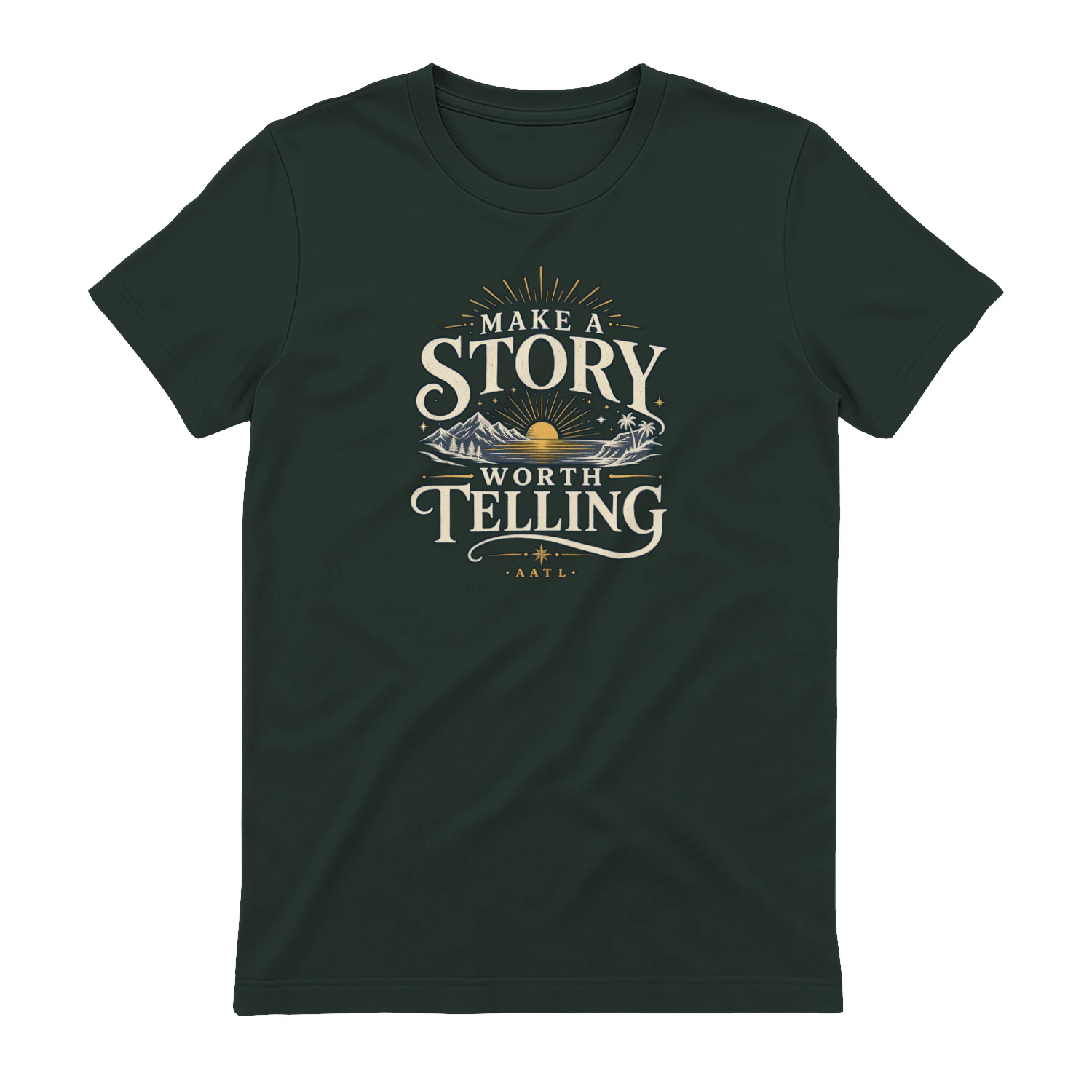
Make A Story Worth Telling
A scenic vintage-inspired design that encourages you to “Make A Story Worth Telling.” Mountains, water, sunset, and tropical details give it an adventurous feel that’s perfect for travelers, explorers, and anyone who wants a life filled with moments worth remembering.