
Video
Why Harry Mack Treats Freestyling as His Clearest Creative Path
Melvin Maya’s reaction to Harry Mack’s Happy Hour Sessions appearance becomes a useful look at why some artists create best without a script, and why process matters as much as the finished verse.
Load the YouTube player to watch here. YouTube receives technical information when its player loads. This does not enable this site's analytics or marketing tracking.
Watch on YouTube ↗The direct answer: Harry Mack trusts the mic more than the page
In this video, Harry Mack makes his position pretty clear: freestyling is the mode that opens up the most for him. Melvin Maya’s reaction gives that answer room to breathe instead of treating it like a throwaway preference. What stands out is not just that Harry likes improvising. It is that he describes freestyling as the place where his style, rhythm, and sense of what he wants to say come together most naturally.
That matters because the episode is not built around a debate for its own sake. It becomes a practical look at how a creator works when the pressure is on and the beat is already moving. Harry’s answer is personal, but it also reads like a working method: he can access more of himself when he is not staring at a blank page trying to force the verse into existence.
What the guest’s prompts pulled out of the session
The freestyle section starts with three ideas: the universal law of attraction, balance, and a personal utopia. Those topics are not random decoration. They give Harry enough structure to move with purpose without boxing him in.
That is part of what makes the session interesting. The prompts are broad, but Harry does not respond broadly. He turns them into a chain of connected thoughts about manifestation, self-discipline, balance, and the way a better world might look if art and honesty mattered more than pressure and commerce. The verses are not presented as polished writing. They feel like live thinking in motion.
Melvin Maya reacts to that in real time, and the reaction works because he is listening for more than rhyme density. He is noticing how the suggestions shape the direction of the freestyle and how Harry keeps returning to the same core ideas from slightly different angles. The result is a performance that feels guided, but never cramped.
Why Harry says writing costs him something
The strongest part of the conversation comes when Harry explains what changes for him between writing and freestyling. He says that improvising lets him reach more of his style and skill set. He also points out something important: when he is freestyling, he can better control rhythm, delivery, cadence shifts, and the little adjustments that make the performance feel alive.
That is the key distinction in the video. Harry is not saying writing is bad in general. He says he likes to write songs, but he does not like to write them down. For him, the act of forcing words onto a page can block the version of himself that shows up when the mic is hot and the beat is playing.
He even describes the discomfort of being in a studio session with a blank page in front of him. The page does not help him settle in. It slows him down. Once he starts rapping, though, things click into place. That is the part Melvin keeps circling back to in the reaction: the feeling that the real process only begins when Harry starts moving.
Melvin’s parallel from video work
One reason the video lands is that Melvin does not just leave Harry’s answer hanging. He connects it to his own experience making videos. He describes how, earlier in his video work, he overthought everything and tried to memorize too much. Over time, he found a better fit: a few bullet points instead of a rigid script, with room to speak naturally once the camera is rolling.
That parallel makes sense because both approaches are about finding a method that preserves the creator’s voice. Melvin’s point is not that scripts are useless. It is that some people sound most like themselves when they have a loose framework and space to improvise.
He also mentions helping other people create videos in a professional setting, where overly elaborate scripts can become a problem. If the goal is to sound human, reading too carefully can work against the result. That observation echoes Harry’s point almost exactly. In both cases, the challenge is not producing words. It is preserving timing, personality, and ease.
The episode’s real subject is creative confidence
At first glance, “freestyling versus writing raps” sounds like a simple craft question. The video shows that it is really about confidence in one’s own process.
Harry Mack says he often does not know exactly what he thinks until he starts rapping. That is a revealing statement, but not because it is dramatic. It is revealing because it treats improvisation like a tool for thought. Freestyling is not only performance for him; it is a way to access clarity. He compares it to meditation in the sense that it helps him zero in and quiet the noise.
That idea gives the whole session a different weight. The conversation is not asking which method wins in a vacuum. It is asking which method helps a particular creator do his best work. Harry’s answer is shaped by how his mind works. Melvin’s response is shaped by how he makes his own content. Put together, the video becomes a practical reminder that process is personal.
What viewers can take from the exchange
The most useful takeaway from this reaction is that creativity does not have to look organized to be deliberate. Harry’s freestyle sounds spontaneous because it is, but it is not careless. The session shows structure, responsiveness, and strong instinct working together.
It also suggests that creators do not need to force themselves into someone else’s workflow just because it looks more formal. Some people do their best thinking on the page. Others do it in motion. Harry Mack clearly belongs to the second group, and Melvin Maya’s reaction does a good job of letting that point stay intact.
That is why the video works beyond the performance itself. It gives you a freestyle, but it also gives you a way of thinking about making things: try the method that helps you sound like yourself.
Watch the original video on YouTube ↗
All About The Life
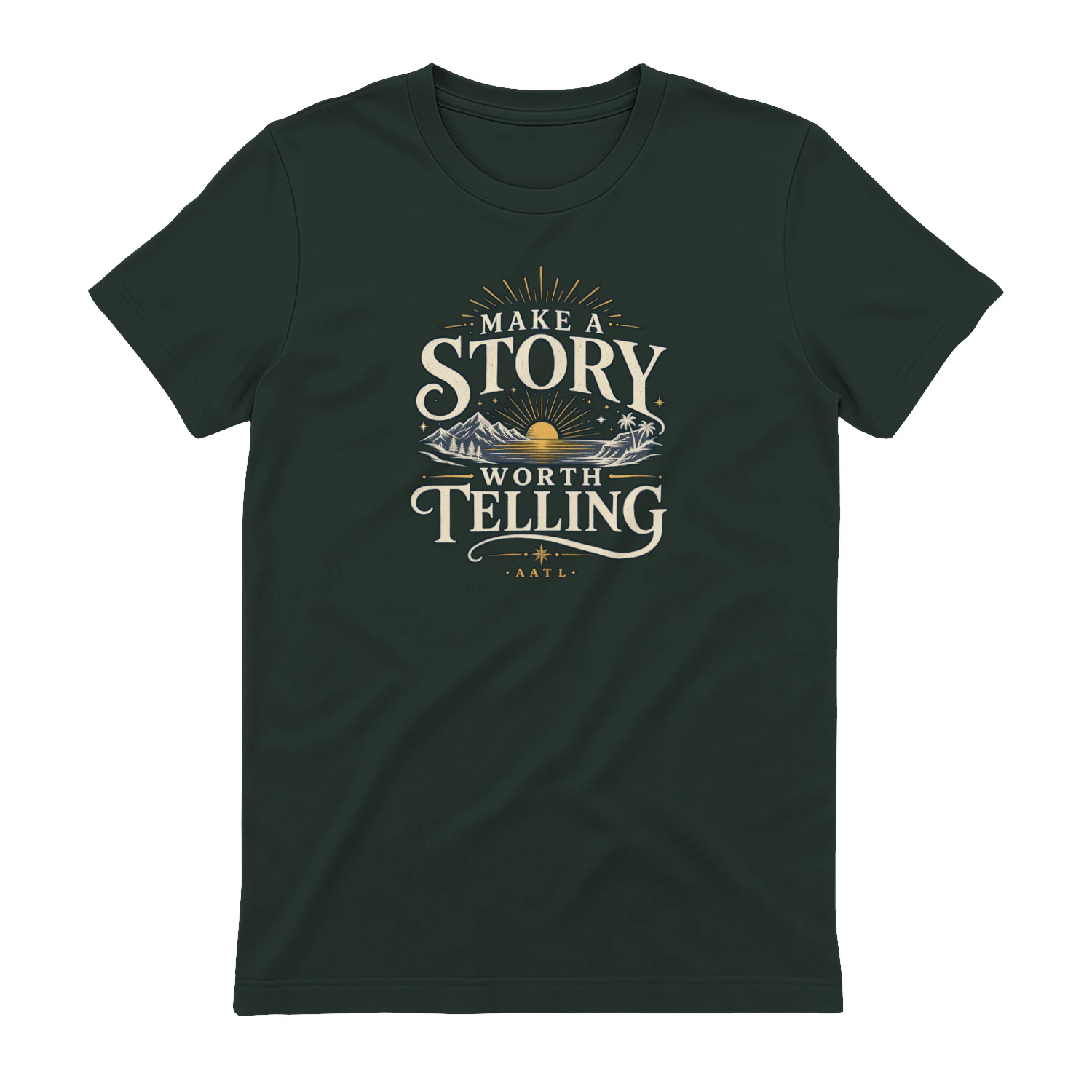
Make A Story Worth Telling
A scenic vintage-inspired design that encourages you to “Make A Story Worth Telling.” Mountains, water, sunset, and tropical details give it an adventurous feel that’s perfect for travelers, explorers, and anyone who wants a life filled with moments worth remembering.