
Video
Why Texas Keeps Slipping Out of the Southern Category
A reaction video becomes a larger argument about scale, identity, and why Texans often describe the state on its own terms.
Load the YouTube player to watch here. YouTube receives technical information when its player loads. This does not enable this site's analytics or marketing tracking.
Watch on YouTube ↗Why Texas keeps refusing a neat regional label
The direct answer is simple: the video argues that Texas is different from the rest of the South because almost every major way of measuring a state points to separation instead of similarity. Size, landscape, population mix, food, road design, city growth, and history all contribute to the same result. Melvin Maya’s reaction does not try to overcomplicate that point. He keeps returning to the idea that Texas feels like its own category, and that is really the backbone of the feature.
What makes the video work is that it does not lean on one argument alone. It builds a stack of them. By the end, Texas is not just “southern with exceptions.” It is presented as a place that repeatedly breaks the expectations people bring to the South.
Scale first: why size changes everything
The first reason in the video is also the easiest one to grasp: Texas is simply huge. The creator compares it with other Southern states and makes the point that Texas does not sit in the middle range the way many of them do. Instead, it lines up more with the West because of its sheer land area.
That size matters for more than bragging rights. In the reaction, the interstate examples make the point feel concrete. A state where exit numbers can reach into the hundreds before you even leave the state changes the way people think about distance. Melvin highlights that part with personal experience, mentioning long drives across Texas and noting how the scale can be hard to internalize until you have actually moved through it.
The video’s larger point is that Texas behaves less like a compact Southern state and more like a place with internal distances large enough to create different local identities inside one border.
Landscape and roads that make the state feel separate
The second and fourth arguments in the video — landscape and roads — connect in a useful way. Texas is shown as a state where geography does not settle into one easy regional pattern. The creator talks through beaches, plains, plateaus, desert valleys, and prairie-like stretches, stressing that the state contains more variety than people often expect. That variety is part of why Texas resists one simple label.
Melvin’s reactions add a grounded layer here. When the video turns to roads, he comments on the concrete paving he has seen and jokes about the constant construction. That keeps the segment from becoming just a list of features. It becomes a lived-in observation about how Texans experience the state every day.
The highway discussion also reinforces size and infrastructure. Texas is portrayed as a state where roads are broader, interchanges are bigger, and speed limits can be higher than the Southern norm described in the video. Whether the subject is the interstate system or surface streets, the message is the same: Texas builds big, and that scale affects how people move through it.
People, cities, and the state’s shifting center of gravity
The demographic section gives the feature one of its clearest distinctions. The video argues that Texas does not fit the usual Southern pattern because no single group forms an overwhelming majority. Instead, the state’s population mix is more varied, with Hispanic Texans forming the largest group and major regional differences across the state.
Melvin responds to this with an immediate connection to Houston and his own background. He points out that Texas borders Mexico and that this helps explain the state’s diversity, then notes that cities like San Antonio carry especially strong Hispanic influence. That observation matters because it moves the point beyond abstraction. The state is not just statistically different; it is visibly different in its cities and neighborhoods.
The city section extends that idea into scale again. The creator compares Texas metros with Atlanta and other Southern urban centers, arguing that Dallas-Fort Worth and Houston sit in a different tier. Melvin questions the way Dallas and Fort Worth are sometimes grouped together, which is a useful reaction because it shows how Texans themselves can be sensitive to the labels used to describe their cities.
The video then widens the frame to Austin, San Antonio, and the spread of major metros across the state. The result is a picture of Texas as a place where the urban story is not dominated by one city but by several large centers, each with its own pull.
Food and history as identity markers
If geography explains separation, food and history explain identity. The food section contrasts Texas barbecue with other Southern barbecue traditions and then shifts to Tex-Mex, which the creator treats as one of the clearest examples of something that belongs to Texas first.
Melvin’s reaction is practical and familiar here. He talks about how much food variety Houston has and notes that Tex-Mex and barbecue are the obvious foods to seek out if someone is only making a short visit. That part of the video works because it shows how regional identity becomes memorable through eating. Food is not presented as decoration; it is part of the state’s self-definition.
History makes that identity even stronger. The video reminds viewers that Texas was once its own republic, and that fact does a lot of the work in explaining why Texans often speak about the state in a different register from other Southerners. It is not just that Texas joined the Union later. It is that the state had its own political life before that, and the video treats that history as a lasting source of pride.
Why Texans say “Texas is Texas”
The strongest recurring idea in the reaction is also the simplest: Texans often do not like being boxed in by outside regional labels. The creator of the video keeps moving toward the same conclusion — that Texas may overlap with the South, the West, the Great Plains, or the Southwest, but it never fully dissolves into any of them.
Melvin clearly enjoys that tension. He laughs at the line “Texas is Texas,” and that reaction captures the whole mood of the feature. It is a phrase that sounds like a joke at first, but in context it becomes a summary of the state’s cultural posture. Texans are not just saying they belong somewhere else. They are saying the state already has a name and identity strong enough to stand on its own.
That feeling shows up again in the closing section on state pride. The Lone Star, the flag, the shape of Texas, and the “Don’t Mess with Texas” slogan all become part of one larger visual language. The video’s point is not that other states lack pride. It is that Texas performs pride differently and more visibly, until the symbols themselves become part of everyday life.
A feature about boundaries, not just borders
By the end of the video, Texas is being described less as a place on a map and more as a state that keeps pushing against neat categories. It is too large, too varied, too historically unusual, and too self-conscious to feel like a standard Southern state. That is why the video lands the way it does: not as a ranking exercise, but as a reminder that regional labels only work when the place being labeled agrees to fit.
Texas never really does.
Watch the original video on YouTube ↗
All About The Life
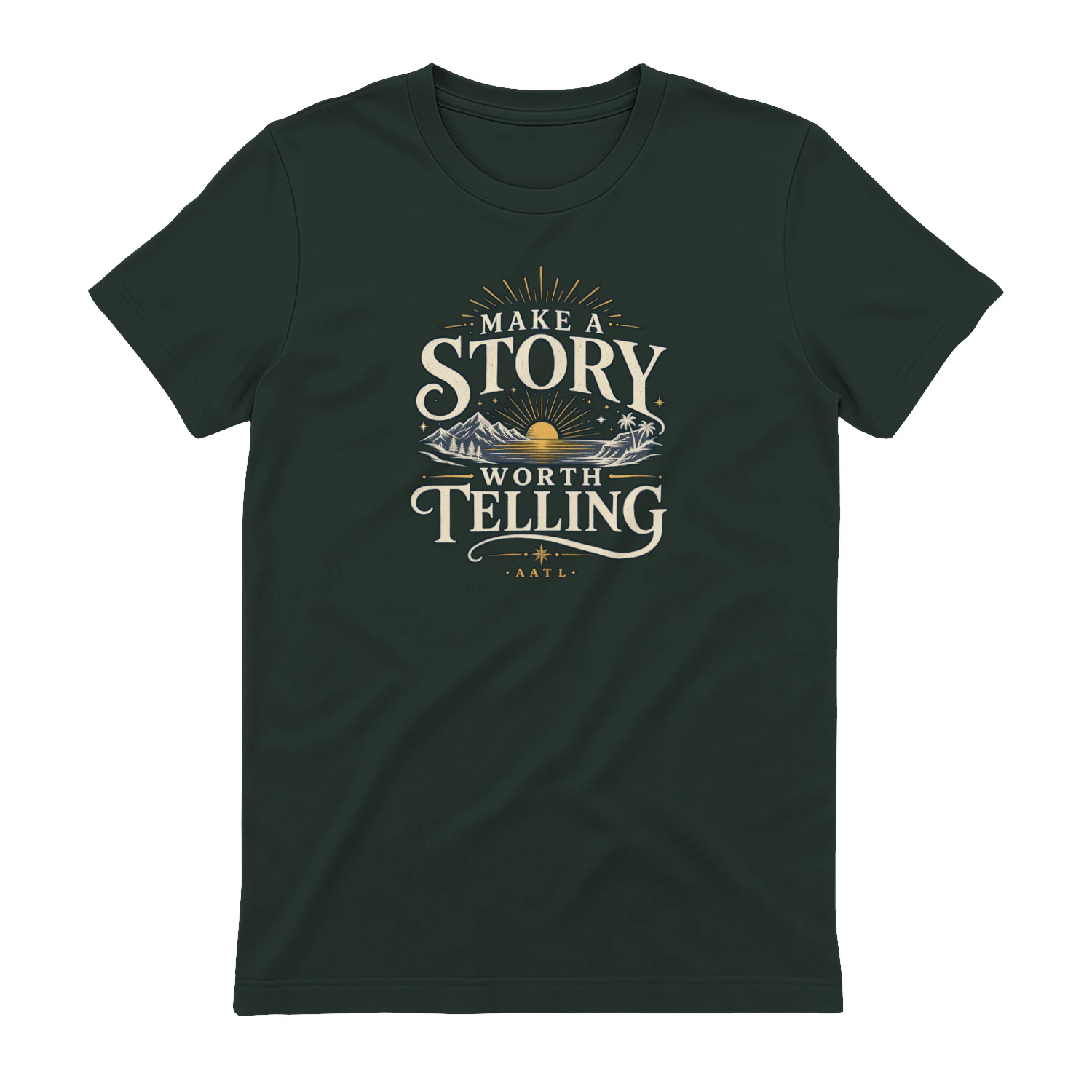
Make A Story Worth Telling
A scenic vintage-inspired design that encourages you to “Make A Story Worth Telling.” Mountains, water, sunset, and tropical details give it an adventurous feel that’s perfect for travelers, explorers, and anyone who wants a life filled with moments worth remembering.