
story
What I’ve Learned Using AI to Build Websites, Content and Marketing Systems in 2026
AI has changed how much I can build and how quickly I can work, but the biggest lessons have been about context, judgment and knowing when speed is actually useful.

There is a version of the AI conversation that makes everything sound almost magical. Type the right prompt, sit back, and suddenly the work is finished.
That has not been my experience.
AI has absolutely changed the way I work in 2026. I use it across websites, content, research, marketing, troubleshooting and a growing list of projects that would have been much slower or less practical for me to build a few years ago. But the biggest improvements have come from learning where AI is genuinely useful and where it still needs a person with enough context to know whether the answer makes sense.
The more I use it, the less interested I am in the idea of AI as a replacement for work. I am much more interested in it as leverage inside a process I understand.
The quality of the context changes everything
One of the first lessons was also one of the most obvious: AI does much better work when it actually understands the project.
A generic prompt can produce a generic answer very quickly. That is not particularly valuable. The useful results come when the system has the right background, constraints, examples, source material and a clear understanding of what “good” means for that specific task.
That matters whether I am working on a website, writing an article, reviewing marketing creative or troubleshooting a technical issue. If the context is weak, the answer may sound polished while still being wrong for the situation.
This is especially important with content. I do not want pages that simply sound like they could be about a subject. I want them grounded in the actual source material, the real project and the experience behind it. AI is much more useful when it helps organize and develop that material than when it is asked to manufacture authority out of thin air.

It has expanded what I can build technically
This is probably one of the areas where AI has changed things most dramatically for me.
I’ve been building WordPress websites from start to finish for more than 15 years. Website architecture, content management systems, SEO, landing pages, integrations and the countless little decisions involved in actually getting a site launched aren’t new territory for me.
What has changed is the type of development I can realistically take on.
Traditional WordPress development and building custom applications are two very different things. In the past, an idea that required a more custom software environment, deeper application logic or significant work directly in code could quickly move beyond the way I normally built websites.
AI has dramatically expanded that boundary.
I can now work much more directly with modern frameworks, databases, APIs, custom application features and technical infrastructure while still approaching the project from the perspective I’ve developed over years of actually building websites.
I can work through how a feature should behave. Understand why something is failing. Examine different ways of solving a problem. Test ideas. Read and understand errors. And iterate much faster than I could before.
That doesn’t erase the difference between my background and someone who has spent their entire career as a software engineer.
What it does is give me the ability to build far beyond the limits of the traditional website projects I’ve been creating for years.
Ideas that once might have required a completely different development path can now become prototypes and, increasingly, real working products.
That change is one of the reasons projects like the network of niche media brands I am building have become practical at the scale I am attempting now.
Speed is useful, but it can also create bad habits
The dangerous part of faster tools is that they make it very easy to do the wrong thing more quickly.
If a workflow is poorly designed, automation can multiply the problem. If the instructions are vague, AI can generate a large amount of content that still needs to be rewritten. If a technical approach is flawed, moving faster can just get you to the failure sooner.
I have had plenty of moments where the right answer was not “make the AI work harder.” The right answer was to fix the process, narrow the task, add a better verification step or stop trying to automate something that needed judgment.
That is a lesson I keep relearning because the temptation is always there. When a tool can produce something in seconds, it is easy to confuse output with progress.
AI is becoming part of my creative process too
The technical side gets a lot of attention, but some of my favorite uses are creative.
I can take a rough visual idea and explore several directions before committing to one. I can use AI as a second set of eyes on a layout, an ad concept or a piece of copy. I can work through names, structures and different ways of explaining an idea without needing every experiment to become a finished deliverable.
That has been useful across both professional marketing work and my own projects.
The important distinction is that I still want the final work to feel specific. The goal is not to make everything look “AI generated.” The goal is to use the tool to reach better ideas, faster iterations and more informed decisions.

Search is changing at the same time
The way people find information is also changing, which makes this even more interesting.
For years, most website strategy centered heavily on traditional search. That still matters, but people are increasingly asking direct questions of AI systems and expecting useful answers without clicking through ten nearly identical pages first.
That does not make good websites less important. I think it increases the value of having clear, useful, well-structured information that can be understood by both people and machines.
It also makes empty SEO content less defensible. A page created only to satisfy a keyword without actually helping the reader has less and less reason to exist.
For me, SEO, answer-focused content and newer AI discovery are becoming parts of the same broader question: did we create something genuinely useful, and did we make it easy to understand what it is about?
Experience still matters
The biggest misconception I see is the idea that access to a powerful tool makes everyone equally capable of using it.
It does not.
If I am evaluating marketing, years of marketing experience influence the questions I ask. If I am building a website, years of building websites affect the problems I notice. When I am working with photography or video, I bring years of visual experience to the decision even if AI helped create part of the concept.
The tool can provide options. Experience helps decide which option is appropriate.
That is why I am more optimistic about AI now than when the hype first exploded. I am not optimistic because I think it removes the need to know things. I am optimistic because I have seen how much more someone can do when they combine a strong tool with knowledge they already earned the slow way.
The real advantage is leverage
If I had to reduce everything I have learned so far to one idea, it would be leverage.
AI lets me explore more ideas, move through repetitive work faster, learn unfamiliar technical territory, test more possibilities and spend more of my attention on the decisions that actually require me.
It has also made it possible to connect parts of my background that used to feel more separate: marketing, web development, SEO, photography, video, content and now more application-level technical work.
I am still learning where the limits are, and those limits move constantly. Some days the tool saves hours. Some days it confidently sends me down the wrong path and I have to unwind it. Both experiences are useful because they make the process better the next time.
We are still very early in this transition. I do not think anybody has the final playbook yet.
What I do know is that AI has already expanded the range of things I can realistically create. The most valuable part has not been asking it to do my job for me.
It has been discovering how much further I can take the work I already know how to do.
All About The Life
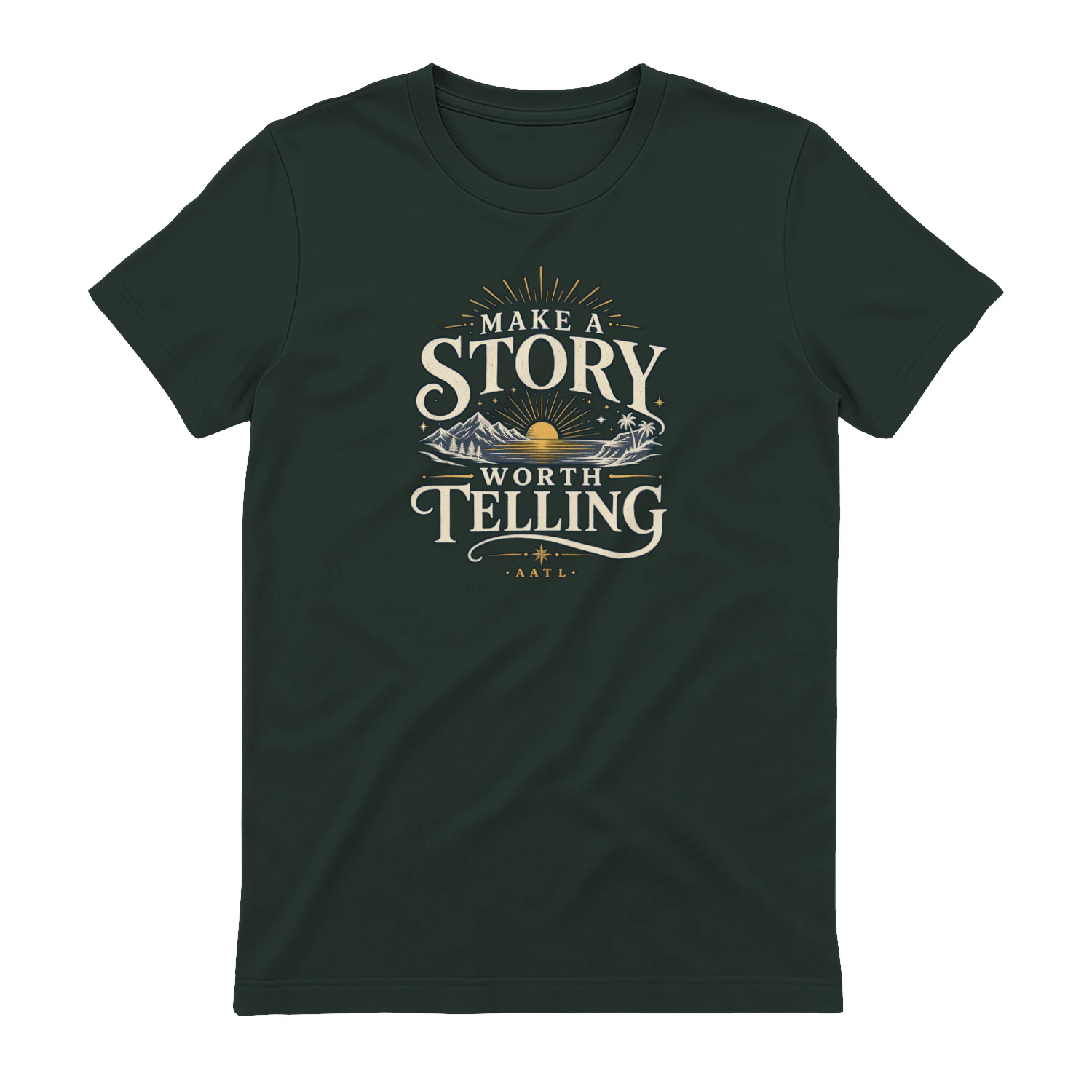
Make A Story Worth Telling
A scenic vintage-inspired design that encourages you to “Make A Story Worth Telling.” Mountains, water, sunset, and tropical details give it an adventurous feel that’s perfect for travelers, explorers, and anyone who wants a life filled with moments worth remembering.